Digital Learning Reimagined
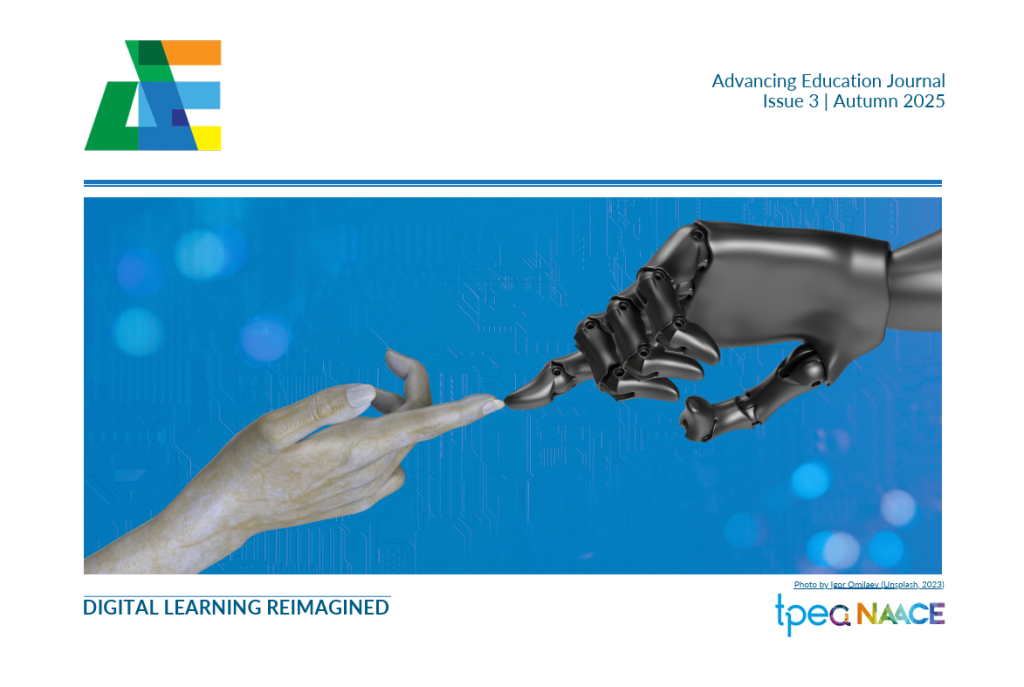
Welcome to the latest edition of Advancing Education: Digital Learning Reimagined. This issue brings together a diverse set of contributions that illustrate how creative and thoughtful digital education can be. Our authors describe a sector that is continually reimagining what learning can look like, spanning early years to university classrooms, and covering themes as various as heritage storytelling, genocide education and AI building learner autonomy.
Two themes thread their way through the collection. The first is Digital Pedagogies Across Contexts. Lucy Tidd shows that even the youngest learners can benefit from carefully introduced technologies that are sensitive to developmental needs and real-world constraints. Julian Ayres and Monty Kennard demonstrate how 360° video and green screen tools can bring history alive and develop a sense of agency for primary pupils engaged in the co-creation of historical spaces. And at the other end of the learner journey, Kenny Hendrickson and colleagues explore how social-emotional factors impact on university students’ navigation of online learning, and why turning cameras off might reflect positive self-awareness rather than disengagement. Similarly, Emma Goto and Chris Shelton remind us that digital participation is not just about skills by suggesting that cultivating reasonableness can help pupils develop the ability to respond to online information in more balanced ways.
A second theme across this edition is Immersive, Ethical and Inclusive Learning, speaking to some of the deeper questions behind digital innovation. Kim Sadique’s compelling piece, Behind the Srebrenica Flower, describes the creation of a virtual Bosnian genocide room that allows learners to explore difficult histories and complex ideas in a sensitive way. Lorna Robinson reflects on the promise and limits of AI for supporting children’s learning, while Alison Hramiak urges us to slow down and question assumptions about technology use. Looking across the whole system, Gavin Davenport, Andy Connell, Christina Preston and Alan Crist raise a key question: how can we ensure every young person in England develops the digital confidence and critical literacy they need to thrive?
Together, these bold and hopeful pieces create a rich picture of digital learning today across learning phases. They highlight how the thoughtful use of creative tools that respond to learners’ needs can deepen understanding whilst also prompting ethical reflection and inclusion.
In the recommended reads, we look ahead to consider what the future for digital competence and skills could look like. We hear from Dr Elizabeth Hidson in her response to the curriculum and assessment review and Professor Sarah Younie about her work presented to UNESCO on teacher agency and artificial intelligence. Raspberry Pi have released their sustainability portal and we finish with a review of Reimagining Teacher Digital Competence (Egan, Johnston and McGarr, 2025) which considers ethical dilemmas raised by professional digital competence demands. It urges readers to take a critical eye to what constitutes digital competence debunking the of a ‘teacher as a technician’, rather reimagining the depth of skills and knowledge needed to be considered digitally competent.
Clear messages are that innovation must ensure that learning is accessible to everyone, not just the digitally confident, and that digital learning is at its best when it keeps humanity at its centre. We hope you enjoy this edition and that it sparks new ideas about how we can continue to reimagine digital education together.