At the end of 2025, as we stand on the threshold of curriculum evolution and prepare for our work in 2026, this feels like a good moment to pause and look back. Interestingly, our excellent 2024 conference in Manchester posed a question that has now proved remarkably prescient: “Facing the future: Are we ready for change?”
Distance offers perspective. Eighteen months on, with the curriculum and assessment review (CAR) now published, I wanted to revisit what we have been saying, worrying about, and advocating for. Time has shown that the themes we explored, and have continued to explore, were plugged in to the changes needed (see what I did there, computing colleagues?).
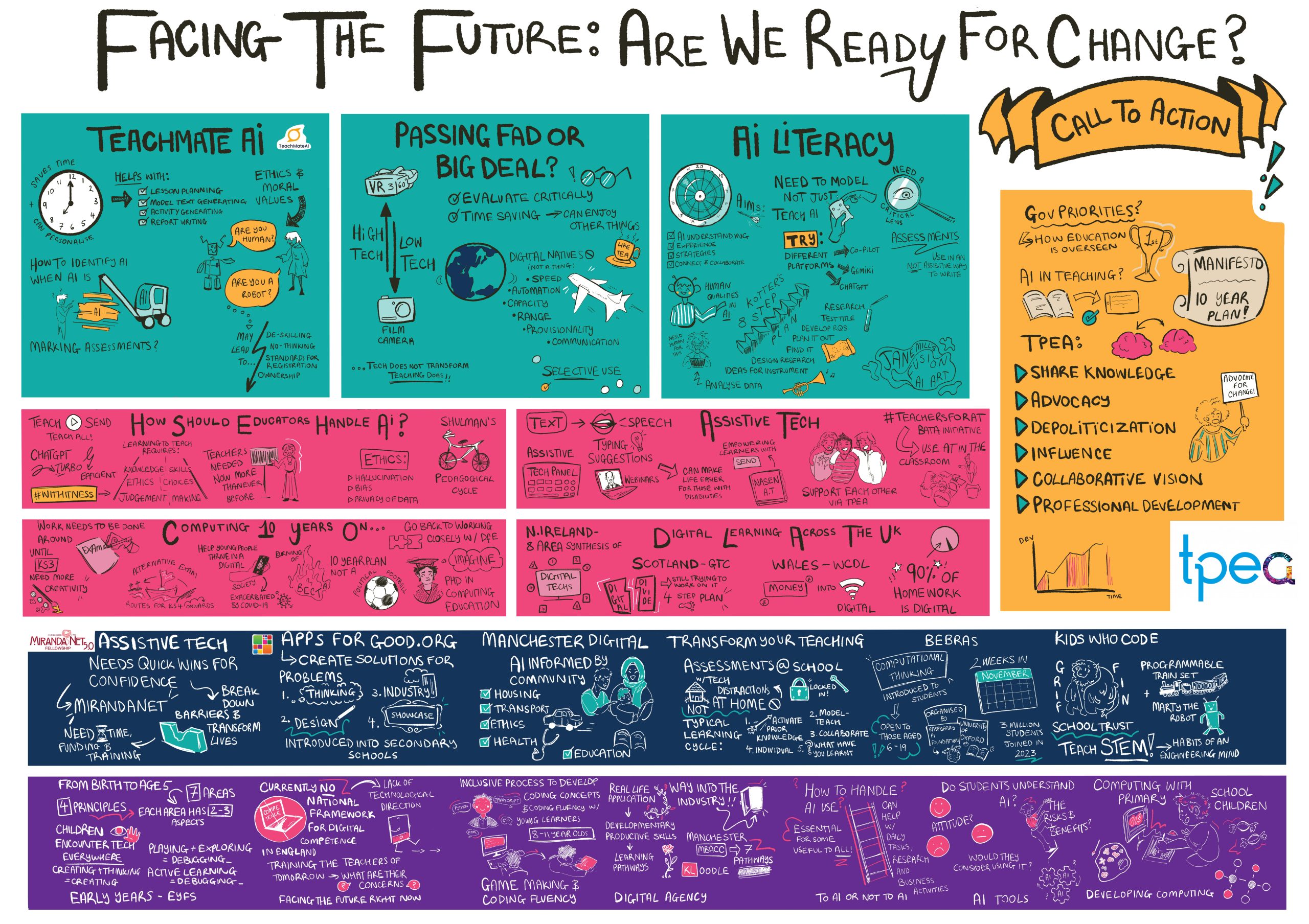
The image accompanying this blog is the sketchnote we commissioned. Looking at it again now, it reads like a roadmap for the challenges the CAR has identified. Our conversations about AI literacy, digital learning, assistive technology, and the need for comprehensive digital skills were clarion calls from our association for what our education system needs.
The themes that shaped our thinking (see sketchnote)
AI literacy
We spent considerable time discussing AI in education, not just as a tool but as a phenomenon requiring critical engagement. How should educators handle AI? These questions haven’t gone away. If anything, they are even more urgent.
Digital learning
Our discussions highlighted the fragmentation of digital skills education across England, Scotland, Wales and Northern Ireland. Each nation has taken different approaches. Our TPEA response to the CAR about digital skills has amplified this important point, and TPEA is ready to work collaboratively with other organisations to shape its direction.
Computing education
The tensions about computing, its computer science, IT, and digital literacy strands have rumbled on since 2013. We now know that this perspective has been validated, and action is planned.
Assistive technology
Our discussions about assistive technology and how educators should approach diverse learning needs speak directly to the CAR emphasis on inclusion in the curriculum, which aligns with work our members are already doing to share guidance and publications.
Our call to action as we look towards 2026
Perhaps most striking about looking back now is seeing our foundational call to action laid out so clearly. This emerged from genuine frustration with the architecture of digital education and the hope that we could rebuild it, better. The policy window has now opened. We can see a clear opportunity for change. Returning to our conference question, we can instead ask “Are we ready for change NOW?”. Perhaps my fellow committee members will support adopting this as our 2026 conference theme? I’ll certainly propose it at our January meeting!
I know the TPEA has been asking the right questions. Looking back has clarified how we should go forward. Writing this blog, somewhere between a review of the year and a set of New Year resolutions for our 40th year, I feel confident that TPEA has a solid foundation for the work ahead, and invite those of like mind to get involved.
Season’s Greetings and Happy New Year from the TPEA!

Dr Elizabeth Hidson
Chair of the TPEA